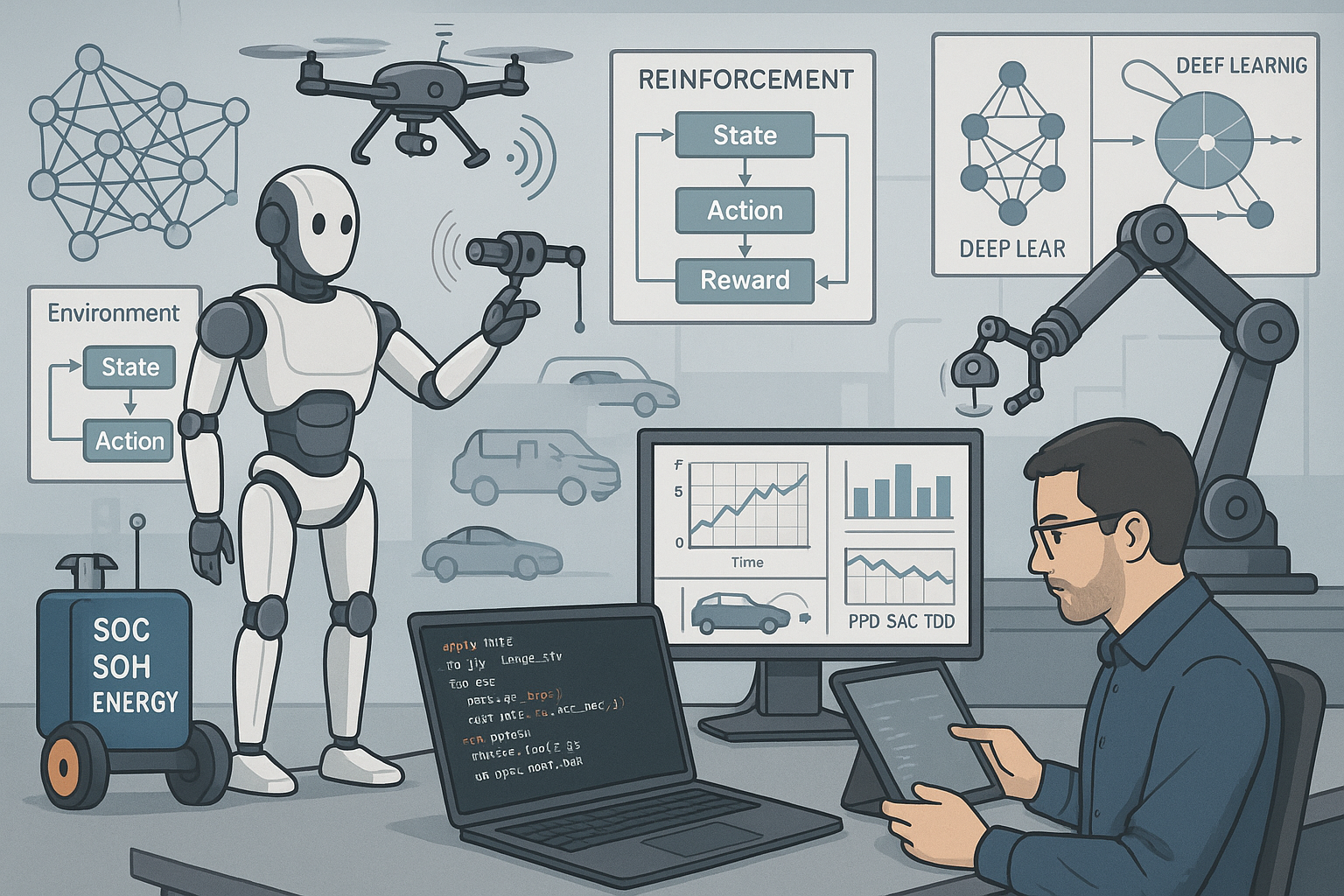
I am an electrical and computer engineering researcher specializing in agentic AI, machine learning, and reinforcement learning. My work spans AI model testing, computer vision, and electric vehicle energy management, with a focus on developing methods for evaluation, prediction, control, and optimization.
As a Postdoctoral Researcher at Carleton University, I am developing agentic AI and agentic reinforcement learning frameworks to evaluate the robustness of image embedding and retrieval models. These projects combine large language models, reinforcement learning, and automated hyperparameter optimization to search for image augmentations that expose retrieval failures while preserving visual realism. My work includes designing iterative optimization workflows, integrating vision-language models, and evaluating image similarity, prediction uncertainty, and retrieval performance.
I hold a Ph.D. in Electrical and Computer Engineering from Carleton University, where my research focused on reinforcement learning for electric vehicle energy management and battery cell balancing. My experience includes multi-agent reinforcement learning, CNN-LSTM forecasting, and state estimation for hybrid energy storage systems.
I develop research software using Python, PyTorch, TensorFlow, Ray RLlib, LangChain, Optuna, and ChromaDB, alongside MATLAB/Simulink. I am interested in applying this combination of AI development and control engineering to practical problems in model reliability, intelligent automation, and energy systems.
armin.lotfy@carleton.ca
Postdoctoral Research Fellow
Agentic and RL Researcher @RavenSoft Lab
System and Computer Department
Carleton University
Ottawa
Canada
Publications
Peer-reviewed- Image Augmentation as Test Generation for Deep Learning-Based Image Retrieval Systems Yehan De Silva, Anirudh Sridhar,Armin Lotfy, Nafiseh Kahani, et all
- Centralized Multi-Agent SOC Control for Battery Health Using Proximal Policy Optimization in EVs Armin Lotfy, Mohamad Alzayed, Hicham Chaoui, Loic Boulon
- Cutting-Edge EMS Technologies for EVs and HEVs: Recent Developments and Future Directions Yashar Farajpour, Armin Lotfy, Hicham Chaoui, Sousso Kelouwani
- Enhancing Energy Management Strategy for Battery Electric Vehicles: Incorporating Cell Balancing and Multi-Agent Twin Delayed Deep Deterministic Policy Gradient Architecture Armin Lotfy, Hicham Chaoui, Mohsen Kandidayeni, Loic Boulon
- An efficient design of Anderson PUF by utilization of the Xilinx primitives in the SLICEM Armin Lotfy, Masoud Kaveh, Diego Martín, Mohammad Reza Mosavi
- An enhanced fuzzy controller based on improved genetic algorithm for speed control of DC motors A Lotfy, M Kaveh, MR Mosavi, AR Rahmati
Cartificates
Projects
-
Agentic AI and Reinforcement Learning for Image Retrieval Robustness Testing
This project focuses on developing agentic AI and agentic reinforcement learning frameworks to evaluate the robustness of image embedding and retrieval models. The frameworks combine large language models, reinforcement learning, and automated hyperparameter optimization to identify image augmentations and their compositions that expose retrieval failures while preserving visual realism. Developed in Python, the project integrates vision-language models and vector databases to assess image similarity, prediction uncertainty, and retrieval performance across different datasets and embedding models.
-
Energy Management of Battery Electric Vehicles Using MATD3 Algorithms
This project focused on developing and implementing a Multi-Agent Twin Delayed Deep Deterministic Policy Gradient (MATD3)-based Energy Management System (EMS) for Battery Electric Vehicles (BEVs). The primary objective was to enhance the driving range of BEVs by integrating an advanced MATD3-EMS with battery cell balancing techniques. The project utilized the MATLAB environment to design, simulate, and optimize the proposed system, aiming to achieve efficient energy utilization and extended battery longevity.
-
Centralized Multi-Agent SOC Control for Battery Health Using Proximal Policy Optimization in EVs
This project proposes a model-free cooperative multi-agent control framework designed to regulate and balance the SOC of lithium-ion battery (LIB) cells in EVs during real-time driving operations. The proposed method utilizes a series architecture comprising three LIB cells, each equipped with a buck-boost converter and a proportional-integral (PI) controller, controlled by a reinforcement learning (RL) agent. The Proximal Policy Optimization (PPO) algorithm is used as the RL agent in this multi-agent framework, where each PPO agent independently manages the SOC of a corresponding battery cell based on observed data. During the training phase, all PPO agents work collaboratively to balance the SOCs of the LIB cells, thereby preventing interruptions in EV performance. The effectiveness of the proposed approach is demonstrated by comparing its performance with single-agent methods such as PPO, Soft Actor-Critic (SAC), and Twin Delayed Deep Deterministic Policy Gradient (TD3), as well as with other multi-agent methods. The results show that the proposed method performs better than the existing approaches, indicating its potential for superior performance.
-
Smart Grid PPO-based Power Controller
In this project, a Proximal Policy Optimization (PPO)-based power-sharing controller was designed and implemented in MATLAB. The controller is robust to unforeseen fault scenarios and demonstrates adaptability in dynamically adjusting power distribution under varying conditions. By leveraging the PPO algorithm, the controller effectively handles uncertainties and ensures reliable power-sharing performance across different operational scenarios, contributing to improved system resilience and efficiency.
-
Predictive Controller of Battery Electric Vehicles Based on MAPPO (Current Project)
This project focuses on developing and implementing a battery controller in Python using libraries such as Stable-Baselines3, Gymnasium, Scikit-learn, and TensorFlow. The primary objective is to design a Reinforcement Learning (RL) and Deep Learning (DL)-based Energy Management System (EMS) capable of adapting to various observation signals and predicting optimal control signals in real time. The system under test is a Battery Electric Vehicle (BEV) equipped with a hybrid energy storage system comprising a battery and a supercapacitor, aimed at achieving efficient energy utilization and enhanced performance.